

The AI Era and Information Overload
The digital transformation has changed the way we interact with information. While AI helps filter and prioritize data, it has also intensified the challenge of information overload.
Imagine this: 40 years ago, people consumed five times less information than they do today. Now, with AI tools, we can access anything within seconds—but the sheer volume of data can leave us feeling more overwhelmed than enlightened and our to-do lists are becoming larger by day.
Mass information is a waste of human energy
Mass information is not just overwhelming—it’s a waste of human energy. In the age of industrial hyperproduction, leaders face a unique challenge: how to address inefficiencies caused by the overproduction of products, services, and data.
The problem is compounded by the fact that much of the information we consume is designed to influence decisions rather than keep the used focused and satisfy actual needs. Think about how many apps, websites, and notifications bombard you with irrelevant data every day.
Making data meaningful through design
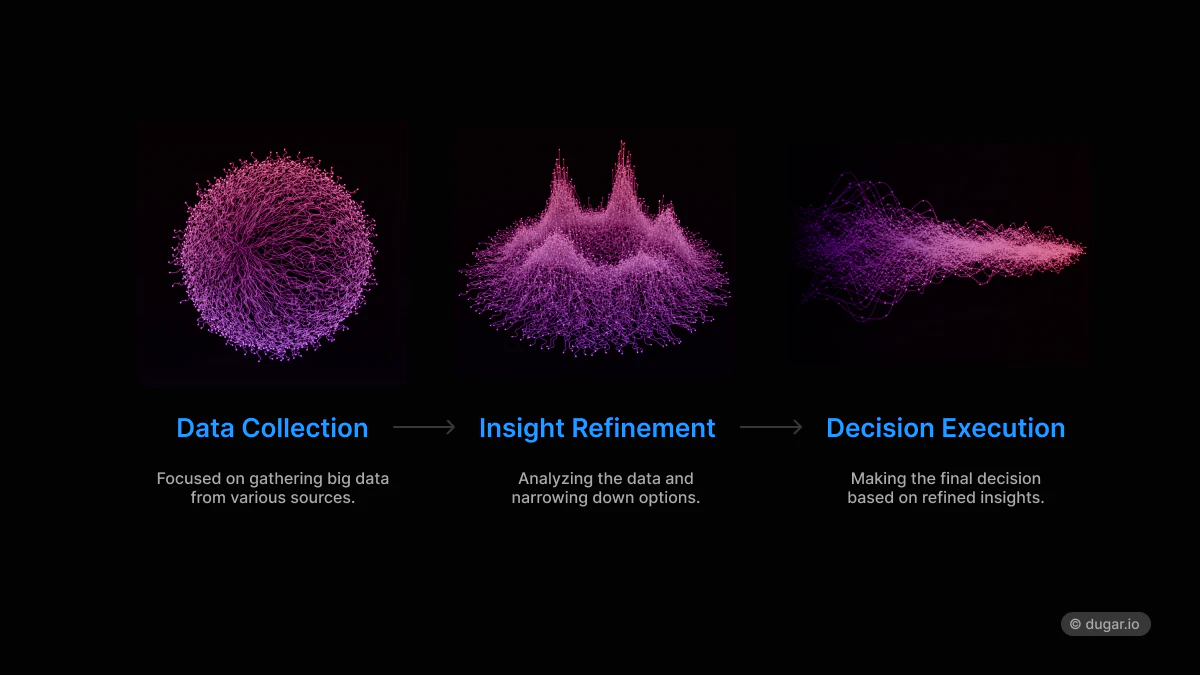
We cannot assume that a heavily personalized and feature-rich service has an advantage over one that has fewer options but is easier to use. In both cases, removing options based on consumers’ decisions made in the past is not a good practice, but neither is overwhelming them with choices. Decision-making makes consumers digitally dizzy while, at the same time, they like to decide on their own.
On the other hand, design based solely on data analysis ignores culture and overlooks human unpredictability. Misunderstanding consumers’ needs based on past behavior is the most common mistake that can ruin an experience.
Example: Just because you went to the gym last week, it is not necessarily the right time for the app to suggest you go again on the same day this week.
System One vs. System Two: Mental modes in decision-making
Builders must account for the two mental modes people use to interact with products:
- System One: Fast, intuitive, and glanceable. Users prefer this mode for quick decisions, such as scanning data visualizations or graphics.
- System Two: Slow, deliberate, and effortful. This mode requires users to solve challenges and expects a reward for the effort.
Since our brains naturally avoid System Two, most experiences need to be designed for System One to remain engaging. However, System Two can be leveraged for deeper interactions when necessary, as long as the reward is clear.
Example: A fitness app can use System One for daily step tracking (glanceable) and System Two for setting long-term goals (reward-driven).
Action plan
- Simplify user experiences: Reduce unnecessary features and focus on usability.
- Balance personalization: Avoid over-reliance on past behavior while considering cultural and contextual factors.
- Leverage AI responsibly: Use AI to filter and prioritize information without overwhelming users.
- Design for System One: Create intuitive, glanceable experiences for quick decision-making.
- Reward effort in System Two: Make users feel rewarded when engaging in deeper interactions.